Wednesday, March 20, 2019


The Sky Is Cheap Entertainment: Worm Moon! Robins Rejoice!

According to Almanac.com, this full moon is called the Worm Moon because: "At the time of this Moon, the ground begins to soften enough for earthworm casts to reappear, inviting the return of robins and migrating birds.
See the 'Super Worm Moon' Rise with the Spring Equinox Today!
Why Is It Called A “Worm Moon”?
Tuesday, March 19, 2019
Educational Links 3/20/19

Dear White Teachers: You Can't Love Your Black Students If You Don't Know Them
6 Strategies for Finding Your Calm
7 Skills Students Will Always Need
More Kids Than Ever Are Dealing With Test Anxiety, and We Need to Help
The Difference Between IEPs and 504 Plans
I’m a Neuroscientist. Here’s How Teachers Change Kids’ Brains.
Teachers change brains. While we often don’t think of ourselves as brain-changers, when we teach we have an enormous impact on our students’ cognitive development. Recent advances in educational neuroscience are helping educators understand the critical role we play in building brain capacities important to students’ learning and self-control.
MzTeachuh's Meditations: Sheltered in the Arms of God

When you are missing your loved one.
Ben Speer - Sheltered In The Arms Of God (Live)
Book Review: Song of the Swallows (March 19 when they return to Capistrano)
 "Song of the Swallows," las golondrinas, is a picture book which won the Caldecott Award in 1949. Written and illustrated by Leo Politi, the story highlights Hispanic customs in San Juan Capistrano, California, that blend nature, Catholicism, and the history of California from a child's perspective.
Juan is the main character, a boy of about seven or eight years old. He attends the school by the Mission, and is a friend of the bell ringer/gardener, grandfatherly Julian. Julian is the only adult mentioned in the book, the Mission is the only setting. The story occurs in the timelessness of childhood, so we don't really know if the illustrations depict the 1940's or not. There is no clue by the clothing, activities, or countryside. The Mission and garden are not dated. There are no automobiles, but even today in coastal California, you might go miles without seeing a motorized vehicle. And there is no clue from the birds; swallows don't follow fashion dictates. One of the main attractions of "The Song of the Swallows" is this untainted marvel-of-childhood quality.

Julian tells Juan about the settling of California by Father Serra and the Franciscan friars. Every fourth grader in this state (myself included) studied this period of California history, and created model missions, maybe even visiting a Mission. There are over twenty missions up and down the California coast, with many cities named after the nearby Mission, i.e., San Diego, Los Angeles, Santa Barbara, and, of course, San Francisco. I've seen a few and the facilities are well maintained and beautiful.
There is no controversy in this book about the treatment of the Indians by the Franciscans.
 |
| A 1985 stamp immortalizing Father Junipero Serra |
The following link is a balanced biography of Father Serra.
Father Junipero Serra also has a statue in the United States Statuary Hall, in Washington, D.C.
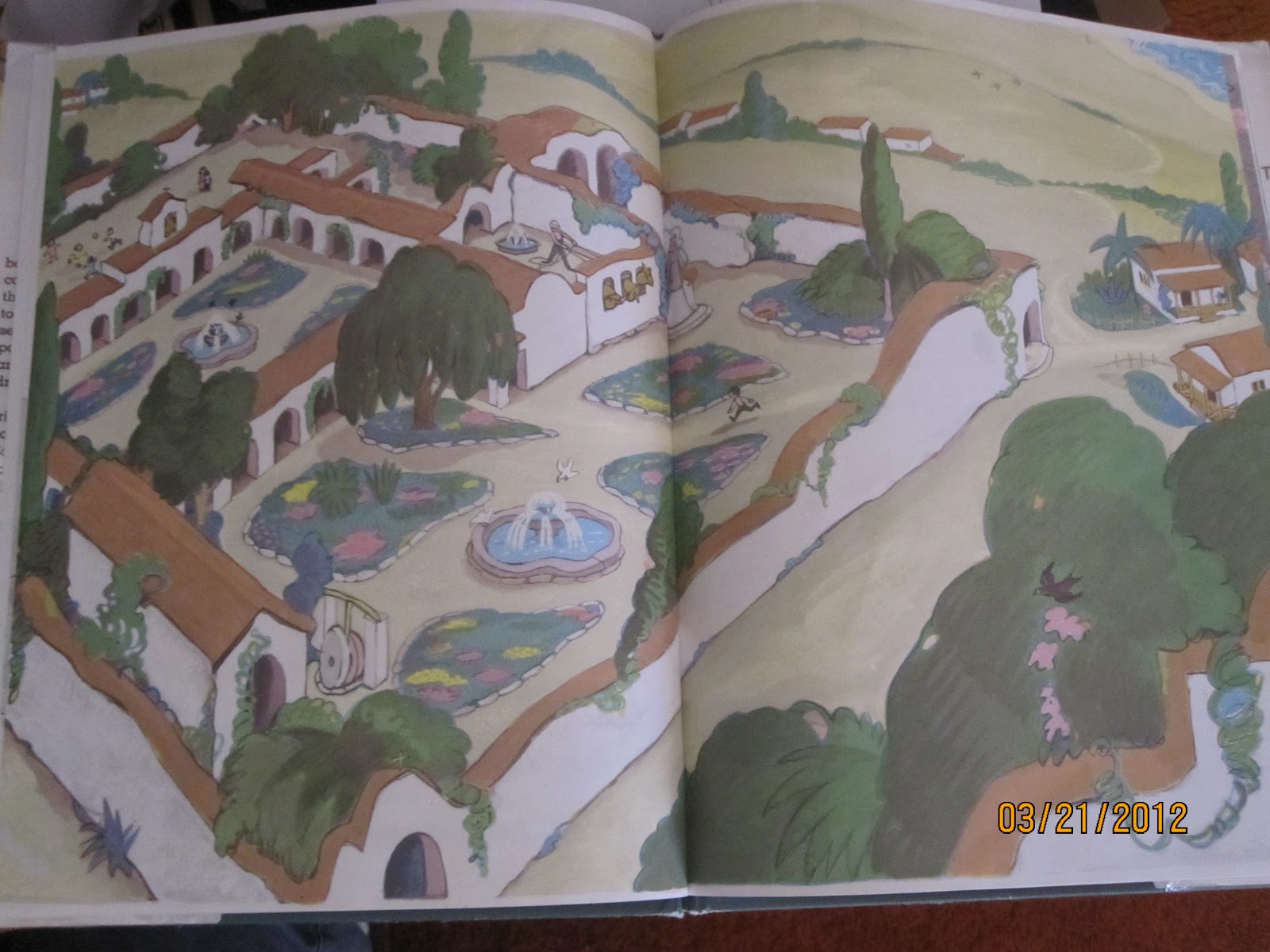 |
| Politi's portrayal of Mission San Juan Capistrano. |

You can purchase this model of San Juan Capistrano for a Grade Four project.
 |
| Julian, the St. Francis look-a-like. |
Julian, in little Juan's eyes, is portrayed almost St. Francis-like with the beautiful garden and hummingbirds, pigeons, sparrows and other birds being comfortable around the gentle soul.
Juan learns of the mystery of the swallows. How do they know to arrive on St. Joseph's Day? (March 19.) It has nothing to do with Joseph, the stepfather of the Savior (of Jesus, Mary and Joseph fame.) It just coincides with the season the swallows migrate to their familiar habitat.
 |
| Happy birdie family, happy boy. |
 |
| Juan wonders about the nests |
Why is there a St. Joseph's Day? In the worship schedule for Catholics, each day has one or more saints honored throughout the year at daily Mass with a feast day, or worship service. For example, many communities have the blessing of the animals on October 4, the feast of Francis of Assisi, to honor his saintly lifestyle that was so peaceful that it is said that even wild animals were gentle with him and birds would perch on him. Francis also propagated peace, forgiveness, and taking care of the poor. Francis lived in twelfth century Italy, and wrote some lovely prayers.
 |
| Happy kids enjoying the beautiful Mission and the birds. |
As the birds get comfortable, the child personifies the male and female birds as the nest is built, the female incubates the eggs, and the male serenades her with sweet, twittering song. Then both the parents diligently feed the hatchlings, like a happy family.
The children thoroughly enjoy the presence of the birds, the spring season, and the safety and contentment of the belief system supplied by the Mission. It is interesting, though, in the story that parents, priests, nuns, teachers or any other adult besides Julian, the grandfatherly gardener, do not make an appearance. Not even an older brother or sister.
In due time, the swallows migrate to a mysterious island for the winter. The human inhabitants of Capistrano will wait for their return. Juan and the other happy kids are very excited when the birds return. The birds actually fly to Goya, Argentina.
 |
| The swallows leave Capistrano on their mission to a mysterious island. |
 |
| Leo Politi |
Leo Politi, although an Italian-America, wrote warmly of the Hispanic culture in Southern California. He authored several children's books. I met him when I was in college in Los Angeles. He was very encouraging to a young English student.
This year in San Juan Capistrano, the swallows are sort of hiding from the big to-do that the residents of Capistrano throw on March 19, St. Joseph's Day. Now the occasion is kind of a mixed metaphor, with a large variety of traditions celebrated, but still a beautiful day out in a remarkably lovely part of the world.
Pat Boone - When The Swallows Come Back To Capistrano
https://www.youtube.com/watch?v=hdGwWywBEU4
This is a wonderful, cheesy song about the swallows returning to Capistrano by Pat Boone recorded in the 1950's, with great pictures of the little birds.
 |
| Singing with Pat. |
Monday, March 18, 2019
Educational Links 3/19/19

Building Teens Into Strong Readers — By Letting Them Teach
The Warm Demander: How to raise expectations (and have students rise to meet them)
Micro-Cloud Learning Series Part 1: The Digital Divide in Education
31 Surprising Facts About Learning
Expecting Too Much-and Too Little? of Literacy Teachers
https://writenow.nwp.org/toomuchtoolittle-b9372407053f?fbclid=IwAR2XXk4ORSmfjGhQPdeuCErh3XYyrAUK5irVpstzT--34gQEhqg1Zj6U73c
The Importance of Emotional Intelligence for Kids With Learning and Attention Issues
7 tips for navigating the shift to open educational resources
https://edscoop.com/7-tips-for-navigating-the-shift-to-open-educational-resources/
Moving from traditional textbooks to open educational resources can improve accessibility to information and save students millions. But a speaker in a recent webinar hosted by edWeb.net say there are a few considerations administrators should keep in mind as they take on the shift to OE.
Sunday, March 17, 2019
Educational Links 3/18/19

It’s Time To Think Differently About Writing In The Classroom
Education software survey
Teaching Students to Paraphrase
Stifled Creativity and Its Toxic Impact on the ADHD Brain
31 Surprising Facts About Learning
Who Is Taking Care of Teachers?
A Rise In Depression Among Teens And Young Adults Could Be Linked To Social Media Use
A study published Thursday in the Journal of Abnormal Psychology finds the percentage of U.S. teens and young adults reporting mental distress, depression and suicidal thoughts and actions has risen significantly over the past decade. While these problems also increased among adults 26 and older, the increase was not nearly as large as among younger people.
Subscribe to:
Posts (Atom)