Showing posts with label US history. Show all posts

Saturday, May 18, 2024

All American Cheesy Jokes and Serious Thoughts


Hurrah for the red, white and silly. And Garfield has just the light-hearted touch we sometimes need.

Try not to turn each of these jokes and riddles into too much of an opportunity to teach, though with younger children, you might have some 'splaining to do, Lucy.

Teacher: Where was the Declaration of Independence signed?
Student: On the bottom.


Teacher: The Declaration of Independence was written in Philadelphia. True or false?
Student: False. It was written in ink.

What did Paul Revere say at the end of his ride? I've got to get a softer saddle.

And just to be teachery, don't forget Longfellow's adventuresome poem, 'The Midnight Ride of Paul Revere.' It's so cheesy, kids love it. 


Paul Revere's Ride


Embarrassed someone saw my crack.

Keep in torch!
Did you hear the one about the Liberty Bell? Yeah, it cracked me up.

What did the visitor say as he left the Statue of Liberty? Keep in torch.

What did one flag say to another--nothing, it just waved.


'What kind of tea do Americans thirst for? Liber--ty. Ha ha.'

                                    What colonists told the most jokes? Punsylvanians.


Very good read.
Now for a serious thought. The greatest founding father, in my opinion, was John Adams. He supported all citizens, and did not believe in slavery, not a bit. He and his family had no connection with slavery at all. He argued in  the Continental Congress for the abolition of slavery, foreseeing the schism it would cause in a new America; which it surely did in the Civil War. He and his wife Abigail supported integration in their home town of Braintree, Massachusetts, in the local school. John Adams had the education, brilliance and insight to see that the colonies needed to empower all the people no matter what; he worried that the British would treat the American colonies as they had Ireland. He was humble enough to recommend Thomas Jefferson be the compiler and writer of the Congress' thoughts, but historians know it was Adams who was the prime thinker. He was an innovative diplomat, a President who would see the big picture, and a faithful and loving husband and father. I think the latter should count for a lot. Thank you, John Adams, for taking care of baby America.


Our Constitution was made only for a moral and religious people. It is wholly inadequate to the government of any other. John Adams
John Adams


Read more at http://www.brainyquote.com/quotes/authors/j/john_adams_2.html?gcl

Tuesday, July 4, 2023

Abraham Lincoln and the Fourth of July


Only Lincoln photo after the Gettysburg Address.
Abe Lincoln made more than one speech about the Battle of Gettysburg, which was fought on July 1,2,and 3 in the year 1863. The battle ended on July 4, 1863. One year later, Lincoln gave the Gettysburg Address on the field of battle in Pennsylvania, November 19, 1864.

Lincoln's background made him the ultimate outsider in Washington; he was from the pioneer West, Illinois. Surely not a person of privilege or social connections. His grandfather had immigrated to Pennsylvania from England around 1740, then after the Revolutionary War the Lincolns moved through the Cumberland Gap Abraham was born in Kentucky, where they settled briefly but the Lincolns moved to Indiana, then Illinois. 

Lincoln the Illinois lawyer 1846
The Lincolns were really poor, but with the stubbornness of the pioneer, they survived and prospered until Abraham was an up-and-coming lawyer. At this time in US history, the West was wide open. The Civil War was destined to explode over greed (the South wanting to expand the plantation system into the West) and the abolitionists' moral indignance over slavery.

So here we are on the Fourth of July. It is impossible to adequately described the horrors of the Civil War. Here are Lincoln's public comments few days after the Battle of Gettysburg, on July 7, 1863. One year later, Lincoln will give the Gettysburg Address. You can see this speech as a precurser to the profound, eloquent speech that Lincoln cogitated over for a year.

"On July 7th 1863, President Lincoln delivered an impromptu Independence Day address to a group of hundreds who gathered outside the White House in celebration of the July 4th victory at Vicksburg. They caught Lincoln off-guard sometime past 8pm, yet he nonetheless stepped outside and delivered this address:
Fellow-citizens: I am very glad to see you to-night. But yet I will not say I thank you for this call. But I do most sincerely thank Almighty God for the occasion on which you have called. [Cheers.]
How long ago is it? Eighty odd years since, upon the Fourth day of July, for the first time in the world, a union body of representatives was assembled to declare as a self-evident truth that all men were created equal. [Cheers.]
That was the birthday of the United States of America. Since then the fourth day of July has had several very peculiar recognitions. The two most distinguished men who framed and supported that paper, including the particular declaration I have mentioned, Thomas Jefferson and John Adams, the one having framed it, and the other sustained it most ably in debate, the only two of the fifty-five or fifty-six who signed it, I believe, who were ever President of the United States, precisely fifty years after they put their hands to that paper it pleased the Almighty God to take away from this stage of action on the Fourth of July. This extraordinary coincidence we can understand to be a dispensation of the Almighty Ruler of Events.
Another of our Presidents, five years afterwards, was called from this stage of existence on the same day of the month, and now on this Fourth of July just past, when a gigantic rebellion has risen in the land, precisely at the bottom of which is an effort to overthrow that principle "that all men are created equal," we have a surrender of one of their most powerful positions and powerful armies forced upon them on that very day. [Cheers.]
And I see in the succession of battles in Pennsylvania, which continued three days, so rapidly following each other as to be justly called one great battle, fought on the first, second and third of July; on the fourth the enemies of the declaration that all men are created equal had to turn tail and run. [Laughter and applause.]
Gentlemen, this is a glorious theme and a glorious occasion for a speech, but I am not prepared to make one worthy of the theme and worthy of the occasion. [Cries of "go on," and applause.] I would like to speak in all praise that is due to the many brave officers and soldiers who have fought in the cause of the Union and liberties of this country from the beginning of this war, not on occasions of success, but upon the more trying occasions of the want of success. I say I would like to speak in praise of these men, particularizing their deeds, but I am unprepared. I should dislike to mention the name of a single officer, lest in doing so I wrong some other one whose name may not occur to me. [Cheers.]
Recent events bring up certain names, gallantly prominent, but I do not want to particularly name them at the expense of others, who are as justly entitled to our gratitude as they. I therefore do not upon this occasion name a single man. And now I have said about as much as I ought to say in this impromptu manner, and if you please, I'll take the music. [Tremendous cheering, and calls for the President to reappear.]
I think in not naming a single man, Lincoln honored all of them. With that sentiment in mind, I post his remarks for all those brave men and women fighting for our nation today, and everyday."
[Gregory S. McNeal]

This is the Gettysburg Address:

Four score and seven years ago our fathers brought forth on this continent, a new nation, conceived in Liberty, and dedicated to the proposition that all men are created equal.
Now we are engaged in a great civil war, testing whether that nation, or any nation so conceived and so dedicated, can long endure. We are met on a great battle-field of that war. We have come to dedicate a portion of that field, as a final resting place for those who here gave their lives that that nation might live. It is altogether fitting and proper that we should do this.
But, in a larger sense, we can not dedicate -- we can not consecrate -- we can not hallow -- this ground. The brave men, living and dead, who struggled here, have consecrated it, far above our poor power to add or detract. The world will little note, nor long remember what we say here, but it can never forget what they did here. It is for us the living, rather, to be dedicated here to the unfinished work which they who fought here have thus far so nobly advanced. It is rather for us to be here dedicated to the great task remaining before us -- that from these honored dead we take increased devotion to that cause for which they gave the last full measure of devotion -- that we here highly resolve that these dead shall not have died in vain -- that this nation, under God, shall have a new birth of freedom -- and that government of the people, by the people, for the people, shall not perish from the earth.
Lincoln is also among the honored dead.

Saturday, November 14, 2020

An Old Fashioned Thanksgiving by Louisa May Alcott (and recipes)


Grandma Moses

http://en.wikipedia.org/wiki/Grandma_Moses 

An Old-Fashioned Thanksgiving


By Louisa May Alcott

http://www.ibiblio.org/eldritch/lma/oft.html 

 Note: be sure not to put catnip or wormwood in the turkey stuffing. Here is an alternative suggestion.


French Bread Stuffing With Mushrooms and Thyme 

http://tayloreducational.blogspot.com/2013/06/french-bread-stuffing-with-mushrooms.html

In our family, the following recipe is called Apple Crisp. Apple desserts by any name would tastes taste as sweet.

Louisa May Alcott's Apple Slump

Serving Size: 8

Filling:
6 tart apples, peeled, cored, and sliced
1/2 cup brown sugar
1/4 tsp nutmeg
1/4 tsp cinnamon
1/4 tsp salt

Topping:
1 1/2 cups flour
2 tsp double-acting baking powder
1/2 tsp salt
1/2 cup sugar
1 egg, beaten
1/2 cup milk
1 stick unsalted butter, melted and cooled
Toss together the apples, sugar and spices and place in a buttered baking dish. Bake at 350F for 20 minutes. While this is baking, prepare the topping, starting by sifting together the dry ingredients. In separate bowl, mix the egg, milk and butter and add this mixture to the dry ingredients, stirring till just combined. Spread the topping over apples and bake at 350F for an additional 25 minutes. Serve with whipped cream or ice cream.

I searched for other short stories of Thanksgiving--modern, showing diversity-- but couldn't find any.

Okay, teachers and others will a Thanksgiving story in your soul just waiting to be expressed, get writing! Next November when I do this search again, I would love to see many Thanksgiving stories. From everywhere. About everyone.  


Monday, February 17, 2020

Black History Month: Black Patriots: Heroes of the Revolution, History Channel


Black Patriots: Heroes of the Revolution
https://www.history.com/specials/black-patriots-heroes-of-the-revolution

Many people don’t know that African Americans played an integral role in the fight for our country’s independence. Anchored by sit down interviews with NBA legend, best-selling author and esteemed activist Kareem Abdul-Jabbar as well as numerous esteemed historians and supported with archival material, “Black Patriots: Heroes of the Revolution” will cover both sides of the fight, highlighting black heroes of the American Revolution who stood up against British rule to help establish the United States of America, and, conversely, black loyalists who fought for the Crown—and the promise of freedom. The documentary will also present Abdul-Jabbar’s personal journey, revealing his own unique discovery of important historical figures like Crispus Attucks and others and how they helped change the perception of his own heritage.

'Black Patriots' Were Heroes Of The Revolution — But Not The History Books


The Death of Major Peirsons, painted by John Singleton Copley. Colonel Tye is pictured left from the center.

Wednesday, May 22, 2019

One Memorial Today

Orvis Henry Sweet, Union Army, Vermont

Orvis, age 21, will be shot in the lung one week after this picture was taken by Matthew Brady in Washington, DC. His younger siblings on the family farm in upstate New York (he volunteered from St. Alban's, Fifth Vermont) grew up and after the Civil War moved West to Idaho, Wyoming, Colorado, and California to become lawyers, Congressmen, ambassadors, journalists and teachers. His father, Haviland Livingston Sweet, died earlier in the War, under the leadership of General McClellan.  Their sacrifice was not in vain.

He volunteered while working at a Print Shop in Vermont, where his family had lived on Grand Isle for generations since the Revolutionary War. His ancestors were Pilgrims and Wampanoags.

He was a regular kid who lived and died for great things.
He fought with his unit through all the major battles of the Civil War, being mortally wounded in the Second Battle of the Wilderness. If you ever watched Ken Burns' documentary on the Civil War, you know how that one was particularly hellish.

http://www.pbs.org/civilwar/

One of Orvis' younger sisters was Alice Eliza Sweet Link, my great grandmother; she went West after the Civil War and became a teacher.


Trip to the Wilderness Battlefields 

http://www.youtube.com/watch?v=5Ege_iMAo5w 


With that haunting music that always brings tears to my eyes, Ashokan Farewell.

Sunday, February 3, 2019

Black History Month: George Washington Carver

George Washington Carver (front row, center) poses with fellow staff members at the Tuskegee Institute (now known as Tuskegee University) located in the U.S. state of Alabama. 1902

George Washington Carver's rise from poverty to a celebrated scientist is just one of the remarkable qualities of his life.

He was born into slavery in 1865, kidnapped at one week old by the KKK, returned to the white family that would later raise him as a son, and was later refused college admission because he was black. He persisted and not only graduated but became a professor. But, in my opinion, these details aren't the most unusual facts about him

He was fascinated by the natural world, and began the study of botany even as a child. With persistence, he graduated from an agricultural college and later became the first black faculty member. He had been the first black student. That's remarkable, but not the most remarkable thing about him.

The eminent educator, Booker T. Washington, invited Carver to the Tuskegee Institute when it first opened in 1896. Carver accepted, and continued there for over forty years until his death. He was internationally recognized. Henry Ford invited him to Dearborn to speak many times (he accepted) and Thomas Edison offered him a fortune to work at Edison Laboratories (he refused.) That's not common.

George Washington Carver chose to remain at Tuskegee because he felt he had a vocation to help the black poor in the South. He is viewed as a 'folk' saint due to his choice to live humbly, with impeccable morality, and frugally when he could have been very wealthy (he left $60,000 to the school when he passed away.) He lived his personal faith for service of his students.

What is the most unusual fact about him? He promoted good relations among the races despite the treatment he received, and he consistently, diligently used his genius to benefit others. Always. That's extremely unique.

His first teacher, after his adopted mother, gave him the following instruction. It appears he really nailed it.


"You must learn all you can, then go back out into the world and give your learning back to the people."

You may also enjoy this post.

What Happens When You Help A Little Kid? 


http://mzteachuh.blogspot.com/2012/07/what-happens-when-you-help-little-kid.html

Friday, May 18, 2018

One Memorial Today

Orvis Henry Sweet, Union Army, Vermont

Orvis, age 21, will be shot in the lung one week after this picture was taken by Matthew Brady in Washington, DC. His younger siblings on the family farm in upstate New York (he volunteered from St. Alban's, Fifth Vermont) grew up and after the Civil War moved West to Idaho, Wyoming, Colorado, and California to become lawyers, Congressmen, ambassadors, journalists and teachers. His father, Haviland Livingston Sweet, died earlier in the War, under the leadership of General McClellan.  Orvis' uncle , John Charles Closson, volunteered from Michigan and was killed, too. Their sacrifice was not in vain.

He volunteered while working at a Print Shop in Vermont, where his family had lived on Grand Isle for generations since the Revolutionary War. His ancestors were Pilgrims and Wampanoags.

He was a regular kid who lived and died for great things.
He fought with his unit through all the major battles of the Civil War, being mortally wounded in the Second Battle of the Wilderness. If you ever watched Ken Burns' documentary on the Civil War, you know how that one was particularly hellish.

http://www.pbs.org/civilwar/

One of Orvis' younger sisters was Alice Eliza Sweet Link, my great grandmother; she went West after the Civil War and became a teacher.


Trip to the Wilderness Battlefields 

http://www.youtube.com/watch?v=5Ege_iMAo5w 


With that haunting music that always brings tears to my eyes, Ashokan Farewell.

Tuesday, February 13, 2018

Black History Month: Strange Fruit


Jacob Lawrence http://en.wikipedia.org/wiki/Jacob_Lawrence


Billie Holiday - Strange Fruit 

Strange Fruit


Southern trees bear strange fruit
Blood on the leaves and blood at the root
Black bodies swinging in the southern breeze
Strange fruit hanging from the poplar trees

Pastoral scene of the gallant south
The bulging eyes and the twisted mouth
Scent of magnolias, sweet and fresh
Then the sudden smell of burning flesh

Here is fruit for the crows to pluck
For the rain to gather, for the wind to suck
For the sun to rot, for the trees to drop
Here is a strange and bitter crop

Lynching in the United States


http://en.wikipedia.org/wiki/Lynching_in_the_United_States 

Thursday, February 1, 2018

Black History Month: George Washington Carver

George Washington Carver (front row, center) poses with fellow staff members at the Tuskegee Institute (now known as Tuskegee University) located in the U.S. state of Alabama. 1902

George Washington Carver's rise from poverty to a celebrated scientist is just one of the remarkable qualities of his life.

He was born into slavery in 1865, kidnapped at one week old by the KKK, returned to the white family that would later raise him as a son, and was later refused college admission because he was black. He persisted and not only graduated but became a professor. But, in my opinion, these details aren't the most unusual facts about him

He was fascinated by the natural world, and began the study of botany even as a child. With persistence, he graduated from an agricultural college and later became the first black faculty member. He had been the first black student. That's remarkable, but not the most remarkable thing about him.

The eminent educator, Booker T. Washington, invited Carver to the Tuskegee Institute when it first opened in 1896. Carver accepted, and continued there for over forty years until his death. He was internationally recognized. Henry Ford invited him to Dearborn to speak many times (he accepted) and Thomas Edison offered him a fortune to work at Edison Laboratories (he refused.) That's not common.

George Washington Carver chose to remain at Tuskegee because he felt he had a vocation to help the black poor in the South. He is viewed as a 'folk' saint due to his choice to live humbly, with impeccable morality, and frugally when he could have been very wealthy (he left $60,000 to the school when he passed away.) He lived his personal faith for service of his students.

What is the most unusual fact about him? He promoted good relations among the races despite the treatment he received, and he consistently, diligently used his genius to benefit others. Always. That's extremely unique.

His first teacher, after his adopted mother, gave him the following instruction. It appears he really nailed it.


"You must learn all you can, then go back out into the world and give your learning back to the people."

You may also enjoy this post.

What Happens When You Help A Little Kid? 


http://mzteachuh.blogspot.com/2012/07/what-happens-when-you-help-little-kid.html

Monday, May 22, 2017

One Memorial Today

Orvis Henry Sweet, Union Army, Vermont

Orvis, age 21, will be shot in the lung one week after this picture was taken by Matthew Brady in Washington, DC. His younger siblings on the family farm in upstate New York (he volunteered from St. Alban's, Fifth Vermont) grew up and after the Civil War moved West to Idaho, Wyoming, Colorado, and California to become lawyers, Congressmen, ambassadors, journalists and teachers. His father, Haviland Livingston Sweet, died earlier in the War, under the leadership of General McClellan.  Their sacrifice was not in vain.

He volunteered while working at a Print Shop in Vermont, where his family had lived on Grand Isle for generations since the Revolutionary War. His ancestors were Pilgrims and Wampanoags.

He was a regular kid who lived and died for great things.
He fought with his unit through all the major battles of the Civil War, being mortally wounded in the Second Battle of the Wilderness. If you ever watched Ken Burns' documentary on the Civil War, you know how that one was particularly hellish.

http://www.pbs.org/civilwar/

One of Orvis' younger sisters was Alice Eliza Sweet Link, my great grandmother; she went West after the Civil War and became a teacher.


Trip to the Wilderness Battlefields 

http://www.youtube.com/watch?v=5Ege_iMAo5w 


With that haunting music that always brings tears to my eyes, Ashokan Farewell.

Sunday, May 21, 2017

Feeling the Melancholy of War

In the US, folks reenact the battles of the Civil War every year. The following link is profoundly insightful--almost ghostly as the reenactors pose in modern America.

 http://www.npr.org/blogs/pictureshow/2012/05/24/153608877/a-civil-war-in-the-olive-garden-parking-lot

The Colonists were mostly interested in finance, right?

I've decided not to include gruesome photos of the dead, or the trenches, or videos of American teenagers losing a leg to an improvised roadside device. 

Instead, here is a well-known poem from WWI.

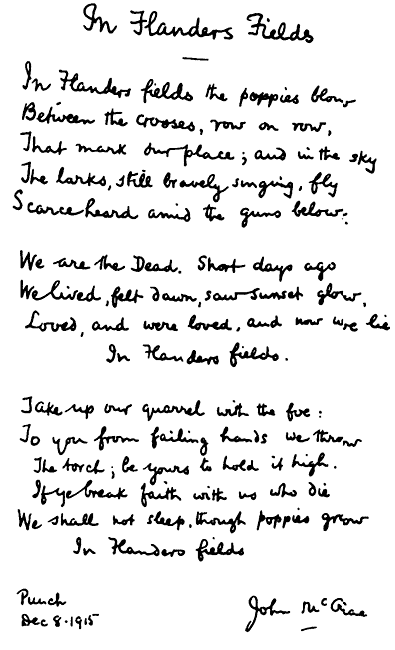
In Flanders Fields
by John McCrae

In Flanders fields the poppies blow
Between the crosses, row on row, 
That mark our place, and in the sky, 
The larks, still bravely singing, fly, 
Scarce heard amid the guns below. 
 
We are the dead; short days ago
We lived, felt dawn, saw sunset glow, 
Loved and were loved, and now we lie
In Flanders fields. 
 
Take up our quarrel with the foe! 
To you from failing hands we throw
The torch; be yours to hold it high! 
If ye break faith with us who die
We shall not sleep, though poppies grow

 Canadian soldiers volunteered for WWI 
after reading this.
 The poem was found in their pockets after they died.